
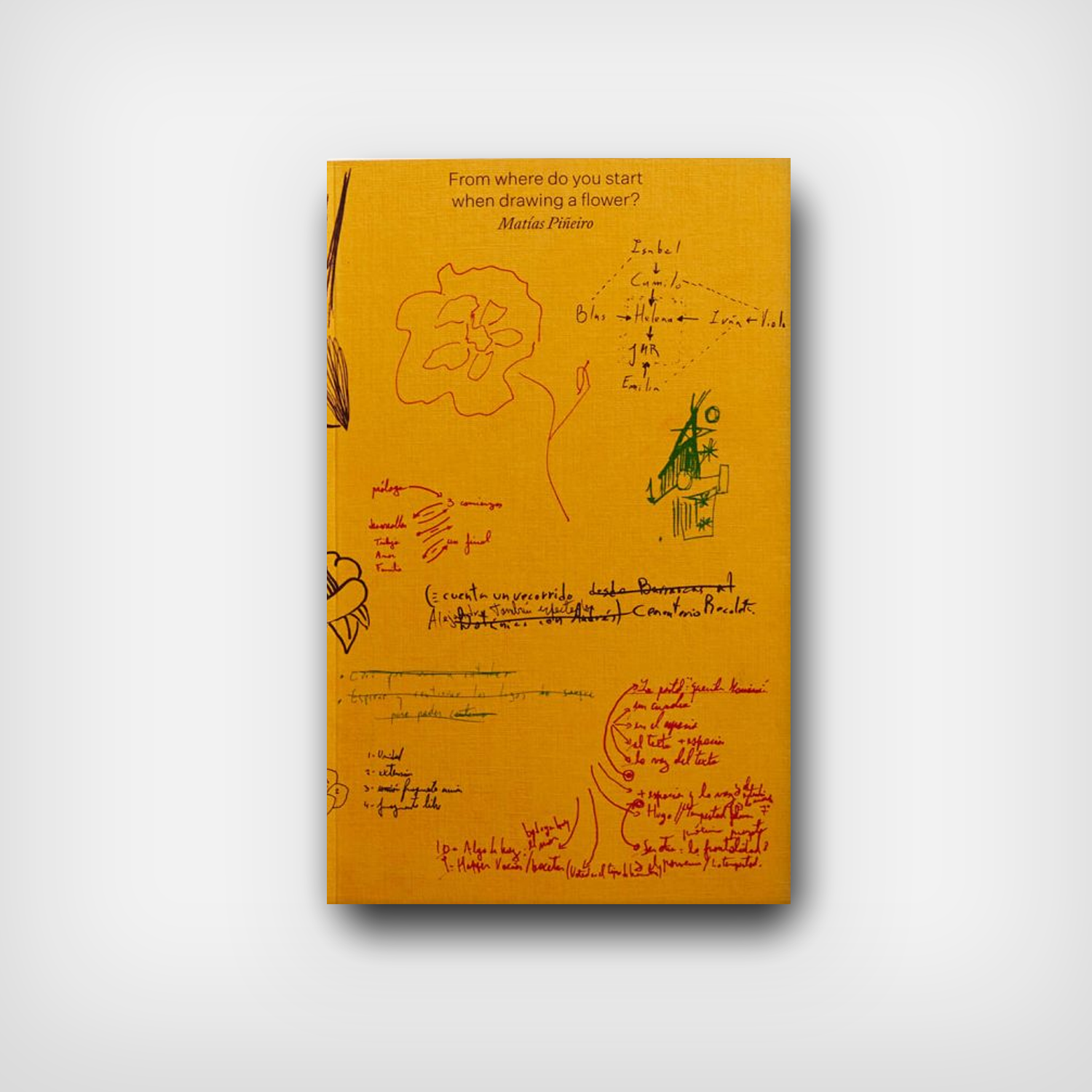
From where do you start when drawing a flower?
The suggestive title of this book - the most comprehensive dedicated to the work of Matias Piñero to date - is not self-explanatory. In fact, it hints at a cryptic poetics. This should come as no surprise. One of the most literary filmmakers of our time, Piñero takes here as his point of departure an element at is both rich in symbolism and deeply rooted in the field of dramaturgy: the flower.
Flowers while signifying kinship and remembrance across history and culture, have also long served as instruments of codification, notably in the plays of Shakespeare that have inspired Piñero. Perhaps the flower that he gifts us here, together with the editor Garbiñe Ortega, embodies this duality; an invitation to both commune and decipher. The present publication, written in direct communication and speech, and at times approaching what we might call an artist book, offers insights into Piñero's process from one film to the next. Covering a period of twenty years, From where do you start when drawing a flower? opens with reflections on his first feature, The Stolen Man, moves through his latest, you burn me, and culminates in a conversation conducted with programmer and critic Dennis Lim, in which previously undisclosed biographical details that complete a certain geneaology of Piñero's cinema are revealed.
Co-published by batalha and Fireflies Press, this book positions us as listeners to the director (who cannot hide his complementary vocation as a pedagogue!) while also embracing the perspectives of several of his longstanding collaborators. Their valuable testimonies help us understand how cinema is indeed developed as a technically diverse and communal practice - something that is often stated but seldom explored on an editorial level. Alongside their words, the writer Daniela Alcívar Bellolio, a close friend of Piñero, offers playful and extended synopses of each film.
Such an unusual approach has resulted in a distinctive and compositive book that unfolds as an enlightening study of Piñero's body of work, tracing formal references, from most the most clear and translucent, to others that surprise even the initiated I believe that, in the following pages, a filmic floriography is born.
- Guilherme Blanc
Autor Matias Piñero
Editor Garbiñe Ortega
Idioma EN
1ª Edição Outubro 2026
Pp. 238
ISBN 978-989-36129-8-9
| Marca | Batalha Centro de Cinema |
|---|